For decades, lockbox processing has played a foundational role in commercial banking and receivables operations.
Banks built entire treasury relationships around lockbox services. Businesses relied on lockbox operations to accelerate cash application, improve liquidity visibility, and streamline payment processing. Lockbox services became deeply embedded in the daily flow of commercial payments.
But the economics of lockbox processing are changing rapidly.
Payment formats have become more fragmented. Remittance data arrives through countless channels and formats. Treasury clients expect faster posting, richer reporting, and real-time visibility. At the same time, banks and financial processors are under enormous pressure to reduce operational costs while improving service quality.
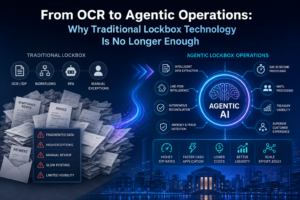
Yet many lockbox operations still rely on outdated workflows built around optical character recognition (OCR), manual exception handling, and fragmented reconciliation processes.
The result is an operational model increasingly burdened by exceptions.
And exceptions are expensive.
Today, the biggest threat to lockbox profitability is no longer simply processing volume. It is the growing cost, complexity, and operational friction created by exception-heavy environments.
This is where agentic AI is beginning to fundamentally reshape the economics of lockbox processing.
The Real Cost of Exception-Heavy Lockbox Operations
Many lockbox operations appear efficient on the surface.
Payments are processed. Deposits are posted. Files move through workflows. Service Level Agreements (SLAs) are met.
But behind the scenes, many operations teams are spending enormous amounts of time managing exceptions manually.
These exceptions include:
- Missing remittance details
- Incomplete invoice references
- Poor-quality payment documentation
- Mismatched payment amounts
- Short pays
- Duplicate remittance information
- Unstructured emails and PDF remittances
- Handwritten documentation
- Multiple remittance formats across customers
Every exception creates operational drag.
When lockbox teams must stop automated workflows to manually investigate transactions, operational costs rise quickly. Employees must review documents, search for supporting information, escalate issues internally, contact customers, and manually reconcile payments.
In many organizations, exceptions are no longer the exception. They have become the workflow.
This creates several major problems:
- Higher cost-to-serve
- Slower cash application
- Increased unapplied cash
- Delayed reconciliation
- Operational bottlenecks
- Staffing pressure
- Reduced scalability
- Poor customer experiences
Many banks and processors underestimate how much manual exception handling is quietly eroding lockbox profitability.
Why Manual Reconciliation Is Destroying Lockbox Margins
Manual reconciliation is one of the largest hidden costs in lockbox operations.
Traditional lockbox systems were never designed to handle today’s fragmented remittance ecosystem. Modern remittance data arrives through email attachments, PDFs, spreadsheets, portals, electronic data interchange (EDI) files, handwritten documents, and customer-generated formats.
Conventional OCR and intelligent document processing (IDP) tools can extract some information from documents, but they often struggle to understand context at the line-item level.
As a result, operations teams are forced to bridge the gap manually.
Employees spend hours:
- Matching payments to invoices
- Identifying missing references
- Resolving discrepancies
- Researching exceptions
- Correcting coding errors
- Handling escalations
- Managing unapplied cash
The financial impact is enormous.
Every manual touchpoint increases labor costs while slowing throughput. Worse, manual reconciliation environments become increasingly difficult to scale as transaction volumes grow.
This creates a dangerous operational equation: Higher payment volumes require more staff, which increases costs and reduces operating leverage.
At a time when fintech competitors are introducing highly automated receivables experiences, many traditional lockbox environments remain operationally dependent on manual labor.
That is not sustainable.
Peak Processing Periods Create Massive Operational Strain
Things are even more challenging during peak periods.
Month-end processing spikes, seasonal fluctuations, acquisitions, and large onboarding events can overwhelm traditional lockbox operations.
In manual environments, scaling often requires organizations to add temporary labor, extend operational hours, increase overtime, delay posting timelines, and accept higher error rates simply to keep pace with growing transaction volumes. This creates operational instability precisely when treasury clients need consistency, speed, and visibility the most.
Lockbox operations leaders frequently face a difficult tradeoff: either increase staffing costs significantly or risk service degradation.
Agentic artificial intelligence (AI) changes this equation entirely.
Rather than scaling through additional human intervention, agentic automation scales through intelligent processing. Modern AI-driven lockbox operations can automatically classify remittances, extract line-item data, match payments, reconcile transactions, identify anomalies, route exceptions intelligently, validate transaction integrity, and apply business rules dynamically in real time.
This dramatically reduces the operational disruption caused by volume spikes.
Instead of adding headcount every time volumes increase, organizations can scale processing elastically while maintaining higher levels of speed, accuracy, and operational consistency.
The Hidden Cost of Unapplied Cash
One of the biggest downstream consequences of poor remittance intelligence is unapplied cash.
When remittance data is incomplete, inconsistent, or delayed, accounts receivable (AR) teams struggle to match payments accurately and quickly.
This creates:
- Delayed posting
- Cash visibility issues
- Increased customer inquiries
- More disputes
- Additional collections work
- Working capital inefficiencies
Unapplied cash is not simply an accounting inconvenience. It is a liquidity problem.
Treasury teams depend on accurate, timely cash positioning to make investment, borrowing, and operational decisions. When payments sit unresolved, visibility suffers.
Many traditional lockbox environments only capture a small fraction of the usable remittance intelligence embedded within transaction data.
Critical context is often lost because legacy systems focus primarily on header-level extraction instead of deep line-item understanding.
This is where line-item intelligence becomes transformational.
Why Line-Item Intelligence Changes Everything
The next generation of lockbox automation is not just about extracting data faster.
It is about understanding transactions more deeply.
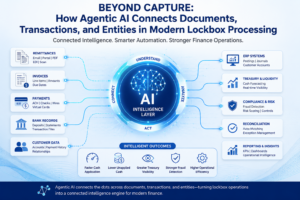
Line-item intelligence allows AI systems to interpret relationships between:
- Invoices
- Payments
- Remittance documents
- Customers
- Enterprise resource planning (ERP) records
- Bank transactions
- Historical payment patterns
This deeper contextual understanding dramatically improves:
- Match rates
- Straight-through processing
- Posting accuracy
- Reconciliation quality
- Exception resolution
- Cash application speed
Instead of merely “reading” documents, agentic AI understands financial context.
This enables systems to autonomously make decisions that previously required human review.
The impact on operations can be substantial.
- Fewer exceptions. With deeper line-item intelligence and contextual understanding, agentic AI can resolve many discrepancies automatically before they become operational problems. This dramatically reduces the number of transactions requiring human intervention and allows operations teams to focus on genuinely complex cases rather than routine mismatches.
- Lower manual review volumes. Traditional lockbox operations often rely on employees to manually validate payments, remittances, and reconciliation details. Agentic AI reduces this burden by autonomously classifying, matching, and validating transactions with a high degree of accuracy, decreasing the volume of transactions routed for manual review.
- Faster posting. When remittance data is captured, interpreted, and reconciled automatically, payments can be posted much more quickly. Faster posting improves cash visibility for treasury and AR teams while helping customers gain quicker confirmation that payments have been received and applied correctly.
- Reduced unapplied cash. More accurate remittance capture and matching improve the ability to apply payments correctly the first time. This reduces the amount of cash sitting unresolved in suspense or exception queues and helps organizations improve working capital visibility and cash forecasting accuracy.
- Improved SLA performance. Agentic AI helps organizations process higher transaction volumes with greater speed and consistency, even during peak periods. This improves an organization’s ability to meet strict posting, reconciliation, and customer service SLAs without relying heavily on overtime or temporary staffing.
- Higher operational consistency. Manual processes often introduce variability depending on staffing levels, employee experience, or transaction complexity. Agentic AI applies standardized logic, validation rules, and reconciliation workflows consistently across every transaction, improving accuracy, predictability, and auditability throughout the operation.
Most importantly, line-item intelligence allows lockbox operations to become scalable without proportional staffing increases.
How Agentic AI Reduces Escalation Chains
Traditional exception workflows often involve multiple layers of escalation.
In many lockbox environments, a single payment exception may move through intake teams, reconciliation specialists, supervisors, customer service representatives, treasury operations teams, and accounts receivable departments before it is finally resolved. Each handoff adds time, labor cost, and operational friction while slowing posting and increasing the overall cost-to-serve.
Agentic AI reduces these escalation chains significantly.
Rather than routing every uncertainty to humans for investigation, AI agents can assess confidence levels, validate transaction patterns, compare historical payment behaviors, detect anomalies, apply reconciliation logic, and make risk-aware decisions automatically in real time. By understanding the broader financial context surrounding each transaction, agentic systems can resolve many routine exceptions autonomously without interrupting operational workflows.
As a result, only genuinely complex or high-risk exceptions require human intervention.
This dramatically changes the operational economics of lockbox processing.
Operations teams spend far less time chasing routine discrepancies and manually researching transactions, allowing them to focus instead on strategic oversight, customer support, and higher-value operational activities.
Real-Time Risk Detection Improves Operational Control
Modern lockbox environments also face growing fraud and compliance risks.
Payment fraud schemes are becoming increasingly sophisticated. Bad actors exploit operational complexity, fragmented remittance data, and manual review gaps.
Traditional lockbox workflows often apply risk checks too late in the process.
Agentic AI enables real-time, risk-aware automation.
AI-driven systems can continuously analyze:
- Transaction anomalies
- Payment inconsistencies
- Behavioral deviations
- Suspicious remittance activity
- Data mismatches
- Unusual payment patterns
This allows organizations to identify risks earlier while reducing manual investigative workloads.
At the same time, fewer human touchpoints reduce exposure to operational errors and insider risks.
The result is a lockbox environment that is not only faster, but also more secure and auditable.
Richer Remittance Intelligence Creates Better Treasury Services
The strategic implications go beyond operational efficiency.
Richer remittance intelligence enables banks and processors to deliver significantly more valuable treasury services.
Treasury clients increasingly expect:
- Faster cash posting
- Better reconciliation visibility
- Cleaner remittance data
- Improved reporting
- Real-time payment visibility
- Integrated receivables intelligence
Banks that modernize lockbox processing can differentiate themselves by delivering a superior treasury experience.
Instead of competing purely on transaction processing, they can compete on:
- Visibility
- Intelligence
- Automation
- Risk reduction
- Customer experience
This becomes increasingly important as fintech competitors continue entering the treasury and receivables market.
Fintechs are aggressively targeting areas where traditional banks have historically struggled:
- Slow onboarding
- Manual workflows
- Exception-heavy operations
- Poor user experiences
- Limited visibility
Modernized lockbox operations help banks defend and strengthen treasury relationships.
Lockbox Is Becoming a Strategic Treasury Platform
The future of lockbox is not commoditized payment processing. It is intelligent receivables infrastructure. As agentic AI continues to mature, lockbox operations are evolving into strategic treasury platforms that deliver real-time receivables intelligence, faster liquidity visibility, automated reconciliation, and risk-aware processing. Instead of simply moving transactions through workflows, modern lockbox environments provide treasury and finance teams with deeper operational insight, richer customer reporting, improved working capital visibility, and scalable operational efficiency.
This fundamentally changes the value proposition of lockbox services.
Modern lockbox operations are no longer viewed solely as processing utilities. They are becoming strategic tools that help banks and processors improve margins, differentiate treasury offerings, strengthen customer retention, scale operations more efficiently, and reduce operational and fraud risk. The ability to deliver cleaner remittance data, faster cash application, and more intelligent receivables workflows is becoming increasingly important as commercial clients demand more visibility, speed, and automation from their banking partners.
The bank lockbox providers that modernize early will be positioned to capture greater operational leverage while delivering significantly better treasury experiences.