For years, lockbox modernization conversations focused primarily on one thing: document capture.
Banks and third-party lockbox processors invested heavily in optical character recognition (OCR), image capture, and document extraction technologies designed to digitize remittances and accelerate payment processing. The goal was straightforward: extract information from documents faster and reduce manual keying.
Those technologies delivered important improvements.
But the limitations of traditional lockbox systems are becoming increasingly clear.
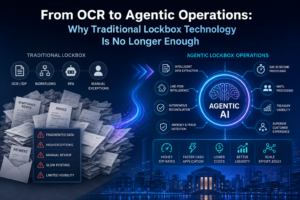
Modern receivables operations are no longer constrained by the inability to “read” documents. The larger problem is that most lockbox environments still fail to understand the relationships between documents, transactions, customers, payments, invoices, bank records, and enterprise resource planning (ERP) systems.
In other words, most lockbox systems capture information, but they do not truly connect it.
This disconnect creates enormous operational inefficiencies across treasury, accounts receivable, finance operations, and banking environments.
That is why the next evolution of lockbox processing is not simply better capture.
It is connected intelligence.
Agentic artificial intelligence (AI) is now transforming lockbox operations by linking documents, transactions, and entities into a unified intelligence layer that enables smarter automation, faster reconciliation, stronger controls, and significantly greater treasury visibility.
The implications extend far beyond lockbox operations alone.
Traditional Lockbox Systems Treat Documents in Isolation
Conventional lockbox systems were built around document-centric workflows.
A remittance arrives. The payment is scanned. OCR extracts key fields. The transaction moves through workflows for validation and reconciliation.
The problem is that traditional systems typically treat each document as a separate event.
The remittance advice exists independently from the customer account, the invoice record, the ERP system, the payment history, the bank transaction, the treasury environment, and the broader receivables ecosystem.
This fragmented approach creates significant operational blind spots.
For example, a traditional OCR system may successfully extract invoice numbers from a remittance document but still fail to understand customer payment behavior, identify historical matching patterns, detect anomalies, recognize duplicate remittances, validate transaction relationships, interpret line-item discrepancies, or connect incomplete remittance information across systems.
As a result, humans are forced to bridge the gaps manually.
This is one of the primary reasons lockbox operations continue to struggle with exception-heavy workflows, delayed reconciliation, high unapplied cash volumes, manual investigations, operational bottlenecks, and inconsistent visibility.
The issue is no longer data capture alone.
The issue is disconnected financial intelligence.
The Hidden Cost of Disconnected Financial Data
Disconnected financial data creates operational friction across the entire receivables lifecycle.
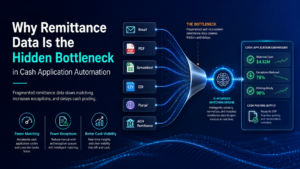
In many organizations, information is spread across lockbox systems, ERP platforms, treasury workstations, customer databases, payment platforms, digital mailrooms, bank systems, spreadsheets, email attachments, and PDF remittances.
Each system contains part of the story.
But very few systems understand the full context surrounding a transaction.
This creates costly downstream consequences.
AR teams struggle to apply cash quickly because remittance information is incomplete or fragmented. Treasury teams lack real-time visibility into pending inflows and liquidity positions. Operations teams spend enormous amounts of time investigating exceptions manually. Fraud and risk teams struggle to identify suspicious patterns because transaction intelligence remains siloed across systems.
The result is slower operations, weaker visibility, higher costs, and increased operational risk.
This is precisely where agentic AI changes the equation.
What Entity-Level Intelligence Means in Receivables Operations
One of the most important advancements in modern finance automation is the emergence of entity-level intelligence.
Traditional document processing systems focus primarily on extracting fields from documents.
Entity-level intelligence goes much further.
Rather than viewing transactions as isolated records, agentic AI understands the relationships between customers, vendors, bank accounts, invoices, payments, remittances, cost centers, ERP records, historical transaction patterns, and approval behaviors. This broader contextual understanding allows AI systems to interpret financial activity much more intelligently and make decisions based not just on individual documents, but on the full operational and financial context surrounding a transaction.
For example, instead of simply extracting an invoice number from a remittance document, agentic AI can identify the customer relationship, compare the payment against historical behaviors, detect unusual payment variances, validate invoice references, match line-item details, interpret partial payments, recognize deductions, detect anomalies, and assess transaction risk levels automatically. By connecting information across systems and workflows, AI agents gain a much deeper understanding of how transactions relate to one another and where potential issues may exist.
This creates a far more intelligent receivables operation.
The system no longer simply captures data.
It understands financial context.
How Agentic AI Connects Documents, Transactions, and Entities
Modern agentic AI platforms act as orchestration layers across financial operations.
Rather than processing documents independently, AI agents continuously connect and validate information across systems and workflows.
This includes linking:
- Payments to invoices
- Remittances to customer accounts
- Bank records with ERP postings
- Customer payment histories to reconciliation logic
- Treasury data and liquidity forecasting
- Digital mailroom inputs to receivables workflows
This connected intelligence dramatically improves operational performance.
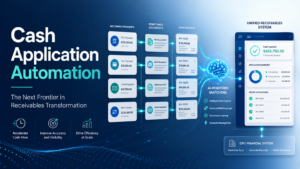
For example, an AI agent can automatically ingest remittance documents from email or portals, extract line-item payment details, match payments against open invoices, validate customer histories, compare transactions against historical behavior, reconcile discrepancies, detect anomalies, route high-risk exceptions, post transactions to ERP systems, and update treasury visibility dashboards.
All of this can happen in near real time.
The result is a lockbox environment that functions less like a manual processing operation and more like an intelligent financial decisioning platform.
Why Line-Item Intelligence Matters So Much
Line-item intelligence is one of the most important enablers of modern receivables automation.
Many legacy systems operate primarily at the document or header level.
But modern financial operations require much deeper understanding.
Line-item intelligence allows AI systems to evaluate invoice line details, quantity variances, pricing discrepancies, partial payments, deductions, credits, short pays, multi-invoice remittances, and customer-specific payment behaviors.
This dramatically improves several critical finance functions.
- Integrated receivables. Integrated receivables environments depend on the ability to normalize and reconcile data from multiple payment channels and remittance formats. Line-item intelligence allows organizations to consolidate information across Automated Clearing House (ACH), checks, wires, virtual cards, lockbox payments, emails, PDFs, portals, and electronic data interchange (EDI) streams into a unified receivables workflow. Instead of forcing operations teams to manually bridge gaps between disconnected payment and remittance sources, AI systems can intelligently organize and connect receivables data automatically. This creates a far cleaner and more scalable receivables environment while improving operational visibility across the entire payment ecosystem.
- Cash application. Cash application improves dramatically when AI systems understand transaction relationships at the line-item level. Rather than relying solely on exact-match logic, AI agents can interpret payment intent, identify probable matches, resolve discrepancies, and automate reconciliation workflows with far greater accuracy. This allows organizations to apply cash faster even when remittance information is incomplete, inconsistent, or fragmented across channels. The result is lower unapplied cash volumes, fewer manual investigations, improved customer experience, and significantly faster posting cycles. This reduces unapplied cash while accelerating posting speed.
- Treasury visibility. Treasury teams depend on accurate receivables visibility to manage liquidity effectively. When transactions remain unresolved or fragmented across systems, forecasting suffers. Connected intelligence allows treasury teams to gain faster, cleaner insight into pending inflows, applied cash, exception volumes, customer payment patterns, and liquidity positions. This gives treasury organizations a more dynamic and current view of enterprise cash movement throughout the day rather than relying on delayed reporting or incomplete reconciliation data. Improved visibility allows treasury teams to optimize liquidity, strengthen forecasting accuracy, and make faster decisions related to investments, borrowing, and working capital management. This improves cash forecasting accuracy and strengthens treasury decision-making.
- Fraud detection and risk scoring. Line-item intelligence also improves fraud detection significantly. AI agents can identify unusual payment behaviors, suspicious remittance patterns, duplicate transactions, inconsistent customer activity, unauthorized changes, and transaction anomalies. Because agentic systems continuously evaluate relationships between documents, payments, customers, and historical transaction behavior, they can recognize subtle risk indicators that traditional rule-based systems often miss. This allows organizations to detect potential fraud earlier, reduce false positives, strengthen compliance monitoring, and improve overall operational security. Because AI systems understand relationships across entities and transactions, they can detect risks earlier and with greater precision than traditional rule-based systems.
Collectively, these capabilities transform line-item intelligence from a simple data extraction enhancement into a foundational layer for modern finance operations. Organizations gain faster processing, greater automation, deeper operational insight, stronger controls, improved treasury visibility, and more intelligent decision-making across the entire receivables lifecycle. In many ways, line-item intelligence is becoming the connective tissue that enables truly autonomous, scalable, and risk-aware finance operations.
How AI Agents Learn Over Time
One of the most powerful aspects of agentic AI is continuous learning.
Traditional workflow systems rely heavily on static rules.
Agentic AI continuously learns from historical transaction behavior, customer payment patterns, reconciliation outcomes, exception histories, approval patterns, operational decisions, and risk signals. Over time, the system becomes increasingly accurate and efficient.
For example, AI agents can learn which customers consistently short pay, which remittance formats create frequent exceptions, which deduction patterns are common, which payment anomalies indicate elevated fraud risk, and which reconciliation paths are most effective.
This creates compounding operational intelligence.
The more the system processes, the smarter it becomes.
This is fundamentally different from traditional OCR or workflow automation environments, which typically require constant manual rule maintenance and configuration updates.
Connected Intelligence Improves Visibility, Compliance, and Control
The value of connected intelligence extends well beyond operational efficiency.
Modern treasury and finance organizations increasingly require real-time visibility, audit-ready workflows, stronger compliance controls, better forecasting, faster decision-making, and improved risk management.
Connected intelligence strengthens all these areas.
- Forecasting and liquidity visibility. When receivables data is fragmented or delayed, treasury forecasting becomes reactive. Connected AI-driven receivables intelligence provides faster insight into incoming cash flows, pending payments, exceptions, and posting status. This gives treasury teams a more current and accurate picture of enterprise liquidity throughout the day rather than relying on delayed batch updates or incomplete reporting. With cleaner, connected receivables intelligence, treasury organizations can make faster investment, borrowing, and working capital decisions with greater confidence. This allows treasury teams to manage liquidity more proactively and accurately.
- Auditability and compliance. Disconnected systems often create audit gaps. AI-driven connected intelligence creates end-to-end traceability across documents, transactions, approvals, and reconciliation decisions. Every action, validation step, and transaction relationship can be documented and tracked automatically, creating a more transparent and defensible operational environment. This reduces the time spent gathering audit evidence manually while improving confidence in the accuracy and completeness of financial records. This strengthens audit readiness, regulatory compliance, internal controls, and governance.
- Operational resilience. Connected intelligence also improves operational resilience. Because agentic systems understand transaction relationships across workflows, organizations become less dependent on tribal knowledge and manual intervention. AI-driven workflows help standardize operational processes across teams and locations, reducing variability caused by staffing shortages, employee turnover, or inconsistent manual practices. This allows organizations to maintain higher levels of operational continuity and scalability even during periods of rapid growth, organizational change, or unexpected disruption. This allows operations to scale consistently while reducing operational fragility.
Lockbox Is Becoming an Intelligence Hub for Modern Finance Operations
The future of lockbox processing extends far beyond payment capture. Modern lockbox environments are evolving into intelligent receivables ecosystems that support integrated receivables, treasury modernization, AR automation, digital mailroom operations, fraud detection, risk scoring, CFO visibility, and real-time finance intelligence.
This represents a major strategic shift. Lockbox is no longer simply a back-office banking operation. It is becoming a central intelligence hub that connects financial data across the enterprise.
The organizations that embrace this shift will be positioned to accelerate reconciliation, improve liquidity visibility, reduce operational costs, strengthen fraud defenses, improve customer experiences, and scale finance operations more effectively. Most importantly, they will move beyond simple automation toward truly intelligent finance operations.