For years, lockbox modernization efforts focused primarily on one objective: digitizing documents.
Banks and financial processors invested heavily in optical character recognition (OCR), intelligent document processing (IDP), workflow tools, and robotic process automation (RPA) technologies designed to eliminate paper handling and reduce manual keying.
At the time, those investments represented meaningful progress.
OCR improved document capture. Workflow tools automated routing. RPA reduced repetitive tasks. Lockbox providers processed higher volumes of payments more efficiently than purely manual environments.
But the economics and complexity of receivables operations have changed dramatically.
Today’s lockbox environments face growing pressure from fragmented remittance formats, rising customer expectations, increasing operational costs, liquidity demands, fraud risk, and the need for real-time treasury visibility.
And many legacy lockbox environments are struggling to keep up.
Why?
Because traditional OCR-centric architectures were designed primarily to read documents, not understand financial operations.
That distinction matters enormously.
The next evolution of lockbox modernization is not simply better extraction.
It is agentic finance operations.
The Problem with Traditional Lockbox Technology
Most legacy lockbox environments still rely on a fragmented technology stack.
A typical workflow often includes OCR or IDP tools for document extraction, workflow systems for routing, RPA for repetitive tasks, manual exception handling, human reconciliation teams, spreadsheet-based investigations, and disconnected treasury and enterprise resource planning (ERP) systems.
At first glance, these environments may appear highly automated.
But behind the scenes, many operations remain heavily dependent on human intervention.
This becomes especially clear when exceptions occur.
And exceptions occur constantly.
Why Manual Exception Handling Still Dominates Lockbox Operations
Despite years of automation investments, many lockbox operations still rely heavily on manual exception handling.
This happens because traditional OCR and workflow systems struggle with the complexity of modern remittance environments.
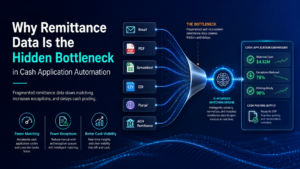
Today’s receivables data arrives through PDFs, emails, ACH remittance files, EDI streams, customer portals, scanned documents, handwritten remittances, spreadsheet attachments, and mixed-format payment documentation.
- Each customer may send remittance information differently.
- Each payment may contain inconsistencies.
- Each exception requires interpretation.
Traditional OCR systems can extract characters and fields, but they often cannot understand financial context.
As a result, operations teams are forced to spend enormous amounts of time manually researching discrepancies, matching payments to invoices, interpreting deductions, resolving short pays, identifying missing remittance details, investigating anomalies, escalating unresolved items, and reconciling fragmented information spread across multiple systems and formats. What should be streamlined digital workflows often become labor-intensive operational investigations requiring significant human intervention and institutional knowledge.
In many lockbox environments, exception handling has effectively become the operational workflow.
That creates significant operational problems. Labor costs continue rising as organizations add staff to manage growing exception volumes. Cash application slows, posting delays increase, unapplied cash accumulates, and operational bottlenecks become more common as payment complexity grows. At the same time, scalability suffers because processing volumes can only increase by adding more people, while inconsistent reconciliation outcomes often create frustrating customer experiences.
What’s needed is operational intelligence.
Why “Reading Documents” Is No Longer Enough
Traditional OCR systems were built around document extraction.
But modern receivables operations require much more than extraction alone.
Financial operations depend on understanding relationships between payments, invoices, remittances, customer histories, ERP records, bank transactions, treasury positions, historical behaviors, and risk signals.
OCR systems typically process documents in isolation. They may identify invoice numbers or payment amounts, but they often cannot understand customer payment behavior, interpret line-item discrepancies, recognize partial payment intent, detect suspicious transaction patterns, connect fragmented remittance data, or apply financial reasoning dynamically.
This is one of the biggest limitations of legacy OCR/IDP + RPA architectures.
They automate tasks. But they do not truly understand transactions.
Modern receivables operations require systems capable of making intelligent operational decisions.
This is where agentic AI fundamentally changes the model.
The Rise of Line-Item Intelligence
One of the most important advancements in modern finance operations is line-item intelligence.
Rather than focusing solely on document-level extraction, line-item intelligence allows artificial intelligence (AI) systems to evaluate financial relationships at a much deeper level.
This includes understanding invoice line details, quantity variances, pricing discrepancies, credits and deductions, short payments, partial payments, customer-specific payment patterns, and multi-invoice remittances.
This level of understanding dramatically improves receivables operations.
Instead of simply extracting fields, AI systems can interpret transaction intent.
This becomes critically important in lockbox environments where payment and remittance complexity continues increasing.
Line-item intelligence allows organizations to improve reconciliation accuracy, reduce unapplied cash, accelerate posting, improve match rates, reduce exception volumes, improve treasury visibility, and strengthen fraud detection simultaneously. Because AI systems understand relationships between invoices, payments, remittances, customer behaviors, and historical transaction patterns, they can make far more intelligent reconciliation and operational decisions than traditional OCR-centric environments.
The operational impact can be substantial. Organizations gain faster and more accurate cash application, cleaner receivables data, stronger liquidity visibility, and fewer manual investigations. At the same time, treasury and finance teams benefit from improved operational scalability, stronger controls, and more proactive risk detection across the receivables lifecycle.
In many ways, line-item intelligence is the foundation of modern agentic finance operations.
Introducing Agentic Lockbox Operations
The next generation of receivables processing is moving beyond static workflows toward agentic operations.
Agentic AI differs from traditional automation because it does not simply follow predefined rules.
Instead, AI agents continuously analyze financial context, evaluate transaction relationships, learn from historical patterns, assess confidence levels, make risk-aware decisions, and resolve exceptions dynamically in real time. Rather than relying solely on rigid workflow logic, agentic systems continuously adapt to changing operational conditions and transaction behaviors, allowing them to make far more intelligent decisions across receivables workflows.
This creates a much more intelligent operational environment.
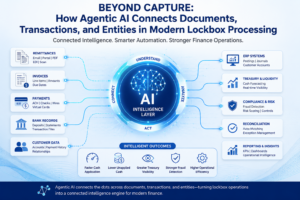
In modern lockbox operations, agentic AI can autonomously handle remittance extraction, payment matching, reconciliation, exception resolution, coding, anomaly detection, validation workflows, risk scoring, and routing decisions. By connecting information across documents, payments, customer histories, ERP systems, and treasury data, AI agents can understand the broader financial context surrounding each transaction and act accordingly.
Rather than routing every uncertainty to humans, AI agents can resolve many issues independently in real time.
This dramatically changes the economics of receivables operations. Organizations can reduce manual touchpoints, improve straight-through processing rates, accelerate posting timelines, and scale operations far more efficiently without continuously adding operational headcount.
The Emergence of NHITL Lockbox Processing
One of the most important concepts emerging in finance automation is NHITL: No Humans in the Loop.
Traditional automation environments still depend heavily on manual review and exception handling.
NHITL environments aim to eliminate unnecessary human intervention entirely for routine processing.
This does not mean humans disappear from finance operations.
It means humans focus on oversight, strategy, customer service, and high-risk exceptions instead of repetitive operational tasks.
Agentic AI makes NHITL lockbox operations increasingly achievable because AI systems can understand financial context, learn from historical outcomes, validate transaction relationships, detect anomalies automatically, resolve routine discrepancies, and apply business logic dynamically.
The result is significantly higher straight-through processing rates with fewer operational touchpoints.
This allows organizations to process more transactions with greater consistency, speed, and scalability.
Why Sub-30-Second Processing Changes Treasury Operations
Speed matters enormously in modern treasury environments.
Traditional receivables processing delays create downstream visibility problems across finance operations.
When payments remain unresolved for hours or days, liquidity visibility suffers, forecasting accuracy declines, cash application slows, treasury decisions become reactive, and customer inquiries increase.
Agentic AI dramatically accelerates processing timelines.
Modern AI-driven lockbox operations can process, validate, reconcile, and post transactions in under 30 seconds.
This creates a major shift in treasury operations.
Treasury teams gain faster visibility into incoming cash, more accurate liquidity positioning, better forecasting inputs, faster reconciliation cycles, and improved working capital visibility.
Instead of waiting for overnight batches or manual reconciliation workflows, treasury organizations gain near real-time operational insight.
This creates a more dynamic and responsive treasury environment.
Richer Remittance Intelligence Improves Customer Experience
The benefits of agentic lockbox operations extend beyond operational efficiency alone.
Customer experience also improves significantly.
One of the biggest frustrations in receivables operations is incomplete or delayed payment visibility.
Customers frequently contact AR teams because payments were not posted correctly, remittance information was incomplete, deductions were unresolved, cash application was delayed, or exceptions remained open too long.
Richer remittance intelligence improves the quality and completeness of receivables data.
This allows organizations to post payments faster, resolve discrepancies earlier, reduce customer inquiries, improve transparency, provide better reporting, and accelerate dispute resolution.
In highly competitive banking and treasury environments, this becomes a significant differentiator.
Organizations increasingly expect faster, cleaner, and more intelligent receivables experiences from their banking partners.
Modernizing Lockbox Without Rebuilding Infrastructure
One of the biggest misconceptions surrounding finance modernization is the belief that organizations must completely rebuild their infrastructure to modernize operations.
Many banks and processors can modernize incrementally.
Modern agentic AI platforms are designed to integrate with existing lockbox systems, treasury platforms, ERP environments, digital mailrooms, payment systems, and workflow applications. This allows organizations to introduce intelligent automation and connected operational intelligence into current environments without replacing core banking infrastructure entirely.
Rather than pursuing costly and disruptive rip-and-replace projects, banks can layer agentic intelligence on top of their existing operational ecosystems. This creates a much faster and lower-risk path to modernization while allowing organizations to preserve prior technology investments and minimize operational disruption.
The benefits can be substantial. Organizations can improve reconciliation quality, accelerate cash application, strengthen exception management, enhance treasury visibility, improve fraud detection, and scale operations more efficiently without overhauling their entire infrastructure stack. By modernizing operational intelligence incrementally, banks and processors can achieve meaningful operational transformation while maintaining business continuity and reducing implementation risk.
Agentic Lockbox Operations Represent the Future of Receivables Processing
The future of lockbox processing is intelligent finance operations. Traditional OCR/IDP + RPA architectures helped digitize receivables processing. But they were never designed to handle the growing complexity, fragmentation, and operational intelligence requirements of modern finance environments. Agentic AI represents the next step. By combining line-item intelligence, contextual understanding, autonomous decisioning, and continuous learning, agentic AI transforms receivables processing into a far more scalable, intelligent, and connected operational model.
This fundamentally changes the role of the lockbox within treasury and finance operations.
The lockbox becomes a liquidity intelligence engine, a treasury visibility platform, a receivables orchestration layer, a fraud and risk detection environment, a customer experience differentiator, and a scalable finance operations hub. Banks and third parties that embrace this shift will be positioned to help their clients reduce operational costs, improve liquidity visibility, speed cash flow, and strengthen customer relationships. Importantly, agentic lockbox solutions help banks and third-party providers modernize their finance operations without rebuilding their infrastructure from scratch.