For years, treasury management innovation has been largely focused on helping businesses move money more efficiently. Banks invested heavily in payment rails, liquidity management, fraud controls, treasury portals, and reporting capabilities designed to help corporate clients manage increasingly complex financial operations.
Those investments remain important. But a growing number of treasury and finance leaders are beginning to recognize that one of the biggest operational pain points in receivables management occurs after the payment arrives.
Applying cash quickly and accurately has become significantly more difficult for many organizations. Payment volumes continue to rise. Remittance data is increasingly fragmented across channels and formats. Customers send payments through Automated Clearing House (ACH), wire, Real Time Payment (RTP), virtual cards, lockbox, portals, and marketplaces, often with incomplete or disconnected remittance information. At the same time, finance departments are operating with leaner staff and greater pressure to improve visibility into working capital and cash flow.
As a result, cash application is rapidly evolving from a back-office accounts receivable (AR) function into a strategic treasury issue.
This shift creates both a challenge and an opportunity for banks. Corporate clients increasingly expect their banking partners to help modernize receivables operations, not simply process payments. Banks that continue to view treasury services primarily through the lens of moving money may find themselves vulnerable to fintechs, enterprise resource planning (ERP) system providers, and emerging financial operations platforms that are positioning themselves closer to the operational workflows clients rely on every day.
The banks that recognize this shift early have an opportunity to deepen treasury relationships, increase client stickiness, and expand their role in helping businesses optimize financial operations.
Why Traditional Cash Application Processes Are Breaking Down
=For decades, many organizations relied on relatively stable receivables processes. Payments arrived through predictable channels. Remittance information was often standardized. Staff manually reconciled incoming payments against invoices and customer accounts using spreadsheets, lockbox files, ERP exports, and email communications.
That model is becoming increasingly unsustainable.
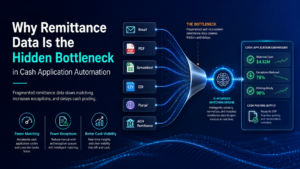
Today’s receivables environment is far more fragmented. A single customer payment may involve multiple invoices, partial payments, deductions, disputes, short pays, or separate remittance documents delivered through entirely different systems. Remittance details may arrive through email attachments, customer portals, PDFs, electronic data interchange (EDI) messages, spreadsheets, or free-form text embedded within payment instructions.
Meanwhile, the growth of electronic payments has accelerated the volume and speed of incoming transactions. While electronic payments improve payment efficiency, they often create downstream reconciliation complexity that many organizations are still trying to manage with outdated workflows.
The challenge becomes even more significant for organizations with large customer bases, decentralized operations, multiple ERP systems, or high payment volumes. Finance teams frequently spend enormous amounts of time tracking down remittance details, resolving exceptions, researching unapplied cash, and manually reconciling payments across systems.
In many organizations, these processes still rely heavily on institutional knowledge held by long-tenured employees. As experienced staff retire or leave, businesses face growing operational risk tied to manual receivables workflows that are difficult to scale and increasingly difficult for staff.
For bank lockbox providers, these operational challenges are becoming impossible to ignore. Clients may successfully receive payments through treasury channels buit still struggle to reconcile and apply those payments efficiently within their financial operations.
That disconnect is creating a major shift in how corporate clients evaluate treasury providers.
The Hidden Operational Costs of Unapplied Cash
Unapplied cash is often viewed as an operational nuisance. It creates broader financial and strategic consequences that directly impact treasury performance and CFO priorities.
When payments cannot be applied quickly and accurately, organizations lose visibility into their true cash position. Forecasting becomes less reliable. Customer disputes take longer to resolve. Collections teams may pursue invoices that have technically already been paid. Month-end close cycles become more complicated. Finance staff spend excessive time researching exceptions rather than focusing on higher-value activities.
The operational costs compound quickly.
Many finance leaders underestimate the burden associated with exception handling and manual reconciliation. Staff often spend hours reviewing remittance documents, comparing invoices, researching deductions, communicating with customers, and correcting posting errors. These activities may not appear prominently on financial statements, but they create significant inefficiencies throughout the organization.
Customer experience can also suffer. Delays in payment posting may create confusion regarding account balances, credit holds, disputes, or collections activities. In industries where customer relationships are highly sensitive, poor receivables operations can negatively impact retention and satisfaction.
From a treasury perspective, unapplied cash creates broader working capital challenges. Organizations increasingly rely on accurate, real-time visibility into receivables to support liquidity planning, investment decisions, borrowing strategies, and executive reporting. Delays in reconciliation undermine confidence in financial data and limit an organization’s ability to make informed treasury decisions.
This is one reason why CFOs and treasurers are beginning to pay much closer attention to receivables intelligence.
Why CFOs Now Care About Receivables Intelligence
Historically, the application of cash was often considered an operational issue managed primarily within AR departments. That perception is changing rapidly.
Today’s CFOs are under increasing pressure to improve forecasting accuracy, optimize working capital, reduce operational costs, and support strategic decision-making with real-time financial data. Treasury teams are expected to maintain tighter visibility into liquidity positions while responding more quickly to changing economic conditions.
These priorities elevate the importance of receivables visibility.
Finance leaders increasingly recognize that incoming payments represent only part of the equation. The real value comes from understanding exactly what those payments represent, how quickly they can be reconciled, and how reliably receivables data flows through the organization.
As organizations pursue broader digital transformation initiatives, many are discovering that fragmented receivables workflows create major blind spots in financial operations. Payments may arrive electronically, but reconciliation often remains highly manual and disconnected from the rest of the treasury ecosystem.
This gap creates an opportunity for banks to reposition themselves.
Corporate clients no longer view treasury management purely as a collection of banking services. Increasingly, they expect treasury providers to help solve operational challenges tied to receivables, reconciliation, data visibility, and financial workflows.
The bank lockbox providers that can help clients reduce friction in these areas may strengthen their strategic relevance significantly.
The Shift from Payment Processing to Financial Operations Enablement
The treasury market is undergoing a broader transformation. Historically, bank lockbox providers primarily competed on transaction execution, payment capabilities, connectivity, and pricing. While these factors still matter, many treasury services are becoming increasingly commoditized.
As a result, differentiation is shifting toward operational enablement.
Corporate clients increasingly want treasury providers that help simplify workflows, reduce manual effort, improve visibility, and automate financial operations. They expect more intelligent experiences that extend beyond simply processing transactions.
This shift is particularly important in receivables management because payment complexity continues to increase. Businesses want integrated visibility across incoming payments, remittance data, exceptions, disputes, deductions, and reconciliation activities. They want treasury systems that help connect operational workflows rather than create additional fragmentation.
Fintech providers and ERP platforms have recognized this opportunity aggressively. Many are positioning themselves closer to the operational processes that finance teams interact with daily. In some cases, these providers are becoming more strategically embedded in receivables workflows than the banks moving the money.
That dynamic should concern treasury product leaders.
If banks remain focused solely on payments while third parties increasingly own receivables intelligence and reconciliation workflows, banks risk losing influence over a critical part of the treasury relationship.
The competitive battleground is expanding beyond payments into financial operations.
How Banks Can Deepen Treasury Relationships Through Receivables Automation
Banks that embrace this evolution have an opportunity to strengthen treasury relationships in meaningful ways.
Helping clients modernize cash application and receivables reconciliation addresses real operational pain points that finance organizations struggle with every day. These challenges are often highly visible to CFOs, controllers, treasurers, and shared services leaders because they directly impact cash visibility, staffing efficiency, and working capital performance.
When banks help solve these problems, they move beyond being viewed simply as transaction providers.
They become operational partners.
This distinction matters because treasury relationships are becoming increasingly competitive. Corporate clients evaluate treasury providers based not only on products and pricing, but also on how effectively they help reduce operational friction and support broader finance transformation goals.
Receivables automation can also create stronger client stickiness. Once treasury workflows become more deeply integrated into reconciliation, reporting, and financial operations processes, switching providers becomes significantly more disruptive.
Additionally, receivables intelligence creates opportunities for broader treasury conversations involving forecasting, liquidity management, working capital optimization, and financial visibility. Banks that help clients improve receivables operations may uncover additional opportunities to expand treasury relationships over time.
Importantly, many organizations are actively searching for guidance in this area. Finance leaders recognize that manual cash application processes are no longer sustainable, but many struggle to identify the right modernization strategy. Banks that proactively help clients navigate these challenges may strengthen both trust and strategic relevance.
What Corporate Clients Increasingly Expect from Treasury Providers
Corporate expectations for treasury technology continue to evolve rapidly.
Clients increasingly expect treasury experiences that feel more connected, intelligent, and operationally aware. They want visibility into payments and reconciliation workflows from a single environment. They expect faster access to accurate receivables data. They want fewer manual touchpoints, fewer exceptions, and less reliance on spreadsheets and email-based processes.
They also expect banks to understand the operational realities finance teams face.
Treasury and finance leaders are dealing with staffing shortages, rising transaction volumes, growing fraud concerns, ERP complexity, and pressure to accelerate digital transformation initiatives. Many organizations are being asked to improve efficiency without adding headcount.
As these pressures intensify, clients increasingly value providers that help automate operational work rather than simply digitizing existing processes.
This expectation is particularly strong among middle-market and enterprise organizations that manage large receivables volumes. These clients often face enormous reconciliation complexity tied to lockbox processing, customer deductions, fragmented remittance formats, and multiple payment channels.
In many cases, the organizations that appear most technologically advanced on the surface are still relying on highly manual receivables workflows behind the scenes.
Banks that recognize these realities can position themselves more effectively as strategic treasury partners.
Strategic Considerations for Banks Evaluating Cash Application Capabilities
As banks evaluate how to evolve treasury offerings, cash application modernization deserves increasing attention.
The goal is not simply to add another treasury feature. The larger opportunity involves helping clients reduce operational friction tied to receivables intelligence, reconciliation, and financial workflows.
Banks evaluating this area should consider several strategic questions.
First, how effectively do existing treasury experiences connect payment movement with reconciliation workflows? Many treasury platforms still treat these as separate operational domains, even though clients increasingly expect unified visibility.
Second, how well can treasury systems handle fragmented remittance data across multiple channels and formats? The ability to normalize, interpret, and connect receivables information is becoming increasingly important as payment complexity grows.
Third, how scalable are current receivables workflows for clients dealing with rising transaction volumes and staffing constraints? Automation is no longer simply an efficiency enhancement. For many organizations, it is becoming operationally necessary.
Finally, banks should evaluate how treasury modernization strategies align with broader shifts toward AI-driven financial operations. Corporate clients increasingly expect intelligent systems capable of reducing manual work, surfacing insights, and improving operational decision-making.
The institutions that move early in this direction may strengthen their competitive positioning considerably.
The Future of Treasury Relationships May Depend on Operational Intelligence
Cash application may not traditionally have been viewed as a strategic treasury battleground. That is changing quickly.
As receivables complexity grows, finance organizations are placing greater emphasis on operational visibility, reconciliation efficiency, and receivables intelligence. CFOs and treasury leaders increasingly understand that incoming payments only create value when organizations can reconcile and apply them quickly and accurately.
This evolution is reshaping client expectations for treasury providers.
Businesses no longer want banks that simply move money. They increasingly want partners that help optimize the operational workflows surrounding those transactions. They want greater visibility, fewer manual processes, faster reconciliation, and more intelligent financial operations.
Bank lockbox providers that recognize this shift have an opportunity to deepen treasury relationships and strengthen their strategic role within client organizations.