For decades, lockbox services have been a cornerstone of commercial banking relationships. They’ve delivered speed, reliability, and operational efficiency in processing incoming payments. But today’s corporate clients aren’t measuring success by how quickly checks are scanned or deposits are posted. They’re measuring success by how quickly and accurately cash is applied inside their enterprise resource planning (ERP) application.
And that’s where the gap is.
For bank product managers, this gap represents both a growing risk and a significant opportunity. The risk is that lockbox becomes increasingly commoditized, vulnerable to pricing pressure and competitive displacement. The opportunity is to transform lockbox from a processing service into a strategic receivables solution by embedding intelligent, decision-capable cash application directly into the offering.
What follows is a closer look at where that gap shows up in day-to-day receivables, and why simply delivering payments data is no longer enough. More importantly, we’ll explore how banks can close it by moving beyond capture to context, decisioning, and execution, transforming lockbox into a true engine for receivables automation.
The Growing Disconnect in Receivables
On the surface, lockbox still performs exactly as designed. Payments are received, opened, scanned, and digitized. Remittance information is captured and delivered. Funds are deposited quickly.
But from the client’s perspective, the job is only half done.
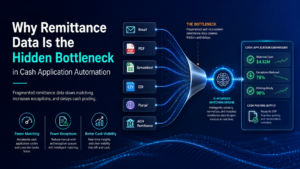
What happens next, matching payments to invoices, resolving exceptions, posting transactions in the ERP, is often still manual, fragmented, and time-consuming. Even in organizations that have invested in automation, there’s often a disconnect between what the bank provides and what the ERP requires.
The result?
- Delays in cash application
- High volumes of unapplied cash
- Increased exception handling
- Limited visibility into true cash position
- Frustrated accounts receivable (AR) teams
This is the reality behind many “modern” receivables environments. And it’s why searches for terms like receivables automation banking, lockbox versus cash application, and integrated receivables solutions continue to rise.
Corporate clients don’t just want data. They want outcomes.
Why Lockbox Alone Falls Short
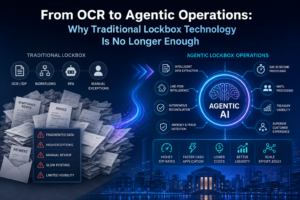
Lockbox was built for a different era where capturing and digitizing payment data was the primary challenge. Today, the challenge is understanding that data, reconciling it, and turning it into actionable financial insight.
Traditional lockbox services typically provide:
- Images of checks and remittance documents
- Extracted data from remittance fields
- Files delivered in standard formats
What traditional lockbox services don’t provide is context or decisioning.
- They don’t interpret complex remittance formats.
- They don’t reconcile partial payments or short pays.
- They don’t resolve discrepancies between remittance data and invoice records.
- And they don’t post transactions directly into the client’s ERP in a meaningful, automated way.
In other words, they stop at data capture, leaving clients to bridge the most complex and labor-intensive part of the process themselves.
This is the fundamental limitation of lockbox in a world that demands true accounts receivable automation. And it’s why many corporates are turning to fintechs and other third-party providers to fill the gap, often outside of the bank relationship.
The Shift Toward Intelligent, Agentic Automation
What’s emerging now is a new class of automation, one that doesn’t just extract data, but understands it, reasons through it, and acts.
Instead of relying on static rules or basic optical character recognition (OCR), these systems operate more like digital operators. They evaluate context across documents, transactions, and historical patterns. They make decisions about how payments should be applied. And they continuously learn and improve over time.
This is the essence of agentic artificial intelligence (AI) in receivables.
In a lockbox context, that means:
- Interpreting unstructured remittance data across formats and channels
- Matching payments to invoices using context, not just exact references
- Identifying and resolving discrepancies automatically
- Orchestrating end-to-end workflows from intake through ERP posting
The result is not just faster processing, but a fundamentally different level of accuracy, adaptability, and scalability.
For banks, this is the technology that enables the leap from data delivery to outcome delivery.
The Risk for Banks: Disintermediation
When banks fail to address the full receivables lifecycle, they create an opening for fintech providers to step in.
These providers don’t just capture data. They orchestrate it. They deliver end-to-end cash application, connecting payments, remittance data, and invoice records into a single, intelligent workflow.
And increasingly, they own the client experience.
For banks, this creates a real risk of dis-intermediation. The lockbox becomes just one component in a broader ecosystem that the bank doesn’t control and doesn’t monetize effectively.
Worse, it potentially weakens the bank’s position as a strategic partner. Instead of enabling the client’s financial operations, the bank will become a vendor of commoditized services.
For bank product managers tasked with driving growth, retention, and differentiation, that’s not a sustainable position.
The Opportunity: Closing the Gap with Cash Application
The good news is that banks are uniquely positioned to solve this problem.
They already sit at the center of the payment flow. They already process the data. They already have trusted relationships with corporate clients.
What’s missing is the final step: transforming captured data into applied cash, intelligently and autonomously.
This is where embedded, agentic cash application changes the equation.
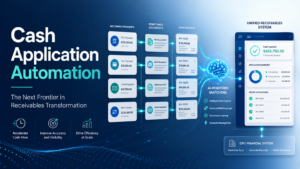
By integrating AI cash application capabilities directly into the lockbox offering, banks can:
- Automatically match payments to open invoices using contextual intelligence
- Handle complex remittance formats and unstructured data without manual intervention
- Resolve exceptions dynamically, based on learned patterns and business rules
- Deliver ERP-ready posting files or post directly into the client’s ERP
- Provide real-time visibility into cash application status and outcomes
In short, bank lockbox providers can move from data delivery to decisioning and execution.
And that’s what clients are looking for.
Why White-Labeled Cash Application Makes Strategic Sense
For many banks, building these capabilities internally is not practical. It requires specialized expertise in AI, data modeling, exception handling, and ERP integration, along with significant time and investment.
That’s why a white-labeled approach is so compelling.
By partnering with a provider that offers advanced, agentic cash application capabilities, banks can embed these solutions into their existing lockbox services, under their own brand, within their own client experience.
This approach aligns perfectly with modern product strategies:
- Accelerate time to market. Instead of multi-year development cycles, banks can deploy new capabilities in weeks. This allows them to respond quickly to client demand and competitive pressure. It also reduces the burden on internal development teams, freeing them to focus on strategic initiatives rather than complex buildouts. In a market where expectations are evolving rapidly, speed is often the difference between leading and lagging.
- Preserve and strengthen client relationships. Clients continue to engage with the bank as their primary provider. The bank owns the experience, the branding, and the relationship. This continuity is critical in maintaining trust, especially as receivables processes become more complex and business critical. By expanding capabilities within the existing relationship, banks reinforce their role as a strategic partner rather than a transactional provider.
- Create new revenue streams. Cash application can be offered as a premium, value-added service, layered on top of existing lockbox offerings. This opens the door to new fee structures tied to automation, accuracy, and performance outcomes. It also enables banks to better monetize the full receivables lifecycle, rather than capturing value from just one part of the process.
- Differentiate in a crowded market. Many banks offer lockbox processing services. But few offer truly integrated receivables solutions powered by intelligent automation. This creates a clear point of differentiation. In competitive RFPs and client conversations, this capability can shift the discussion from price to value. It positions the bank as forward-thinking and innovative. These qualities strongly resonate with modern treasury teams.
- Reduce client attrition. By solving a critical pain point, banks increase stickiness and reduce the likelihood that clients will seek third-party alternatives. When cash application services are tightly integrated with lockbox, it becomes harder for clients to unbundle services without disrupting their operations. This creates a more durable, long-term relationship and strengthens overall client retention.
From Lockbox to Integrated Receivables
The end goal isn’t just better lockbox. It’s integrated receivables.
Integrated receivables solutions bring together all payment channels, including checks, ACH, wires, and cards, into a unified experience. They provide a single view of incoming payments and a single process for applying them.
But without robust, intelligent cash application, integrated receivables fall short.
They may aggregate data, but they don’t necessarily resolve it.
Cash application is the engine that makes integrated receivables work. It’s what turns incoming payments into posted transactions, usable data, and actionable insight.
For banks, this is a critical realization.
If you want to compete in integrated receivables, you can’t stop at aggregation. You must deliver reconciliation and increasingly autonomous reconciliation.
What Modern Cash Application Looks Like
To truly close the gap, banks need more than basic automation. They need intelligent, adaptive systems that can operate with a high degree of autonomy.
Modern cash application solutions should:
- Extract line-item detail from remittance documents, not just header-level data. This level of granularity enables more precise matching and eliminates the need for manual interpretation of supporting documents. Agentic systems go further by understanding how line items relate to each other, recognizing patterns, dependencies, and context that static extraction tools simply miss.
- Understand unstructured formats, including emails, PDFs, and scanned images. Today’s remittance data arrives in countless formats, many of which don’t follow consistent structures or templates. Intelligent systems can interpret meaning across these formats, dynamically adapting to new layouts and using contextual cues to extract and organize relevant data without requiring predefined rules.
- Match payments across multiple invoices, customers, and payment types using contextual reasoning. Real-world payments rarely align neatly with a single invoice, requiring systems to evaluate multiple variables simultaneously. Agentic AI enables this by analyzing historical behavior, customer patterns, and transaction context to make informed matching decisions, even when reference data is incomplete or ambiguous.
- Identify and resolve discrepancies automatically, without human intervention. Exceptions such as short payments, deductions, and missing references are a major source of manual effort in receivables. Agentic AI systems can not only detect these discrepancies but also determine the most appropriate resolution path, applying logic, prior outcomes, and business rules to act autonomously.
- Continuously learn and improve from historical data and user feedback. Traditional automation relies on static rules that require ongoing maintenance and tuning. In contrast, agentic systems evolve over time, learning from each transaction, adapting to new scenarios, and refining their decision-making to improve accuracy and reduce exceptions.
- Integrate seamlessly with client ERP systems. Cash application doesn’t end with matching. It must be translated into accurate, timely posting within the ERP. Intelligent systems can align their outputs with ERP requirements, dynamically adjusting formats, fields, and workflows to ensure smooth, end-to-end execution without manual intervention.
The Path Forward for Bank Product Managers
The shift from lockbox to integrated receivables is already underway. The question is whether banks will lead it or follow it.
To move forward, product managers should:
- Reassess the lockbox value proposition. Ask yourself: Is your lockbox offering solving your clients’ biggest receivables challenges, or just part of them?
- Engage clients on cash application pain points. Understand where delays, exceptions, and manual effort are occurring. These insights will shape your strategy.
- Evaluate white-label partners. Look for providers that offer advanced, agentic capabilities, fast deployment, and seamless integration, without disrupting your existing infrastructure.
- Define a monetization strategy. Position cash application as a premium service that delivers measurable ROI to clients.
- Build a roadmap toward integrated receivables. Cash application is a critical step, but it should be part of a broader vision for modernizing receivables.
Closing the Gap and Capturing the Opportunity
Lockbox isn’t going away. But it’s no longer enough. Banks must evolve beyond data capture to deliver true receivables automation. White-labeled, agentic cash application solutions can help banks deepen client relationships, unlock new revenue streams, and position themselves as leaders in the next generation of treasury services.