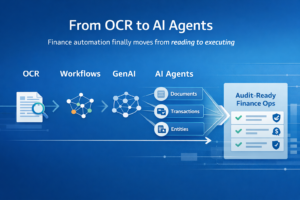
A year ago, most “AI in finance” conversations still sounded like: Can it read the invoice? Can it summarize the email? Can it pull the fields?
Now the bar has moved. The interesting question is: Can it do the work – then show its work?
That shift is happening fast. Gartner reported 58% of finance functions were using AI in 2024, up sharply from 2023. And Deloitte’s latest CFO Signals found 54% of CFOs say integrating AI agents into finance is a top transformation priority for 2026.
So why does it still feel like so many teams are stuck cleaning up the same mess?
Because adoption isn’t the bottleneck. Defensibility is.
Ardent’s State of ePayables 2025 puts a hard number on it: straight-through invoice processing is 35.4%. That’s the gap between “we automated intake” and “the operation runs itself.”
The moment systems start executing, finance starts interrogating
Once a system is allowed to act – code, match, approve, apply cash, clear exceptions – the follow-up questions change:
- Why did it choose that GL and cost center?
- What policy did it apply?
- What did it match against, exactly?
- Who signed off if it was outside tolerance?
- If an auditor asks, can we answer in 30 seconds without scrambling?
Execution without proof is just a faster way to create new exceptions.
What this looks like on the ground: real use cases by segment
Not “future state.” This is where teams feel the pain today – high volume, lots of edge cases, and very little patience for mystery decisions.
Shared Services
1) “We automated AP… but exceptions became the work.”
The pattern is familiar: invoices get ingested cleanly, but then you hit the messy middle – coding, PO alignment, receiving gaps, approvals, and policy checks. A proof-driven execution layer doesn’t just route an exception; it creates an exception packet: what failed, what’s missing, what rule was violated, what data it referenced, and who can fix it.
2) 3-way match that actually closes the loop
Instead of “match failed,” you get:
- line 4 price variance is outside tolerance
- receipt missing for PO line 2
- duplicate invoice number detected across suppliers (and why it thinks so)
That’s the difference between automation that looks good on a dashboard and automation that reduces rework.
3) Vendor inquiries stop eating the week
Shared services teams lose an absurd amount of time answering the same supplier questions. The use case isn’t “generate an email.” It’s: respond with status + remittance detail + what’s blocking payment (with approvals and audit trail behind it), so the team isn’t manually reconstructing the story every time.
Banks
1) Wholesale lockbox: getting from remittance to posting without chaos
Lockbox is execution-heavy. It’s not enough to read a remittance document – you have to apply cash correctly, at line-item depth, across messy stubs, PDFs, and emails. The “proof” matters because the first time a client disputes an application, ops needs to show exactly what was matched, what was assumed, and what rule triggered an exception.
2) Integrated receivables reconciliation that’s explainable
When payments and remittance don’t line up, the worst outcome is a black-box “confidence score.” Banks need traceability: payer identity logic, invoice matching rationale, short-pay handling rules, and a clean breadcrumb trail for client support and internal controls.
3) Digital mailroom that doesn’t end at routing
A lot of mailrooms are basically sorting centers. The real win is when the incoming document triggers execution: classify → extract → validate against system-of-record → route with the evidence attached. That’s how you keep queues from multiplying.
Office of the CFO
1) Month-end close support you can hand to a reviewer
This work is delivery at scale. The use case isn’t “draft a reconciliation.” It’s “build a review-ready package”: source docs, extracted fields, validation checks performed, policy applied, and what changed between draft and final. Faster closes are great—audit-ready closes are better.
2) Coding recommendations that don’t feel risky
Controllers don’t mind recommendations. They mind recommendations with no rationale. Proof-driven execution means every suggested mapping has receipts: policy match, historical pattern, threshold checks, and what would happen if posted as-is.
3) Audit requests that stop derailing the team
When someone asks “show support,” the goal is not hunting through email threads. It’s producing a clean packet: document → decision → approval → posting, with timestamps and context.
Finance automation is entering a more serious phase. It’s not just about reading documents faster or routing work to the right queue. It’s about systems that can take action – code, match, apply cash, clear exceptions—without creating new risk in the process. That only works when execution is paired with proof: clear rules, traceable decisions, and an audit-ready trail that explains what happened and why. In shared services, banks, and the Office of the CFO, that’s the difference between “we automated intake” and “we actually scaled the operation.”
Read the first post in this series to see how finance automation is shifting from document processing to true execution.