Bank CEOs must do more than manage the business. They are expected to transform it.
They are being asked to drive profitable growth in a competitive environment. To modernize client experiences without ballooning costs. To manage risk more proactively. And to ensure their banks are not just experimenting with artificial intelligence (AI) and other intelligent technologies but operationalizing it in ways that deliver measurable outcomes.
For treasury product managers and line-of-business leaders, this creates both a challenge and an opportunity.
The challenge is clear: legacy treasury products such as lockbox processing, receivables, payables, and liquidity management, were not designed for the speed, complexity, or intelligence CEOs now expect.
The opportunity is just as clear: agentic AI offers a path to transform these products from operational utilities into strategic growth engines.
This article shows how treasury leaders can translate that opportunity into action, aligning agentic AI with the CEO’s agenda and embedding intelligence into the workflows that drive growth, efficiency, and risk management.
The CEO Agenda: What Treasury Leaders Are Being Asked to Deliver
Across financial institutions, CEO priorities tend to cluster around four themes:
- Profitable growth and deeper client relationships. CEOs are not just looking for new revenue. They are looking for higher-quality revenue that is sticky, scalable, and defensible. Treasury leaders are expected to help drive this by embedding value into everyday client interactions, not just through pricing but through differentiated capabilities. That means turning treasury products into platforms that deepen engagement, increase wallet share, and make the bank harder to replace.
- Operational efficiency and cost discipline. Cost pressure is not episodic. It is structural, and CEOs expect continuous improvement, not one-time reductions. Treasury operations, often burdened by manual processes and exception handling, are a prime target for transformation. Leaders are being asked to deliver efficiency gains that scale with growth, not ones that require proportional increases in headcount.
- Risk management and regulatory confidence. CEOs are increasingly measured by how well they anticipate and mitigate risk, not just how they respond to it. Treasury functions sit on the front lines of payments, liquidity, and client activity, making them critical to the bank’s risk posture. Leaders must ensure that processes are not only effective, but consistent, auditable, and defensible under regulatory scrutiny.
- Innovation that moves beyond pilots into production. There is growing fatigue at the executive level with AI initiatives that never scale. CEOs want to see tangible business impact, not proofs of concept that live in isolation. Treasury leaders are expected to take ownership of turning innovation into operational capability that delivers measurable return on investment (ROI).
Together, these priorities redefine what treasury is expected to deliver, moving it from a supporting function to a measurable driver of growth, efficiency, and risk control. The question is how quickly treasury can execute against this mandate.
What Makes Agentic AI Different and Why It Matters
Traditional automation tools extract data or execute predefined rules.
Agentic AI goes further.
It understands context, makes decisions, and acts across workflows, connecting documents, transactions, and entities in real time.
In treasury environments, this means:
- Reading remittance data and matching it to payments automatically. Agentic AI doesn’t just capture data. It interprets it in context, even when formats are inconsistent or incomplete. It can reconcile structured and unstructured inputs, learning from historical patterns to improve accuracy over time. This dramatically reduces manual cash application work and accelerates the availability of funds for clients.
- Identifying anomalies before they become losses. Instead of relying on static thresholds, agentic AI evaluates behavior across entities, transactions, and time. It can detect subtle deviations that signal risk, often before traditional systems would flag them. This allows banks to move from reactive exception handling to proactive risk prevention.
- Routing exceptions intelligently or resolving them without human intervention. Not every exception requires human review, and agentic AI knows the difference. It can resolve common issues autonomously while escalating only those that truly require judgment. This ensures that human expertise is focused on high-value decisions rather than routine clean-up.
- Continuously learning from patterns across clients and transactions. Every interaction becomes a data point that improves future performance. The system adapts to new formats, behaviors, and edge cases without requiring constant reconfiguration. Over time, this creates a compounding advantage in both efficiency and accuracy.
For treasury leaders, the shift is profound: You are no longer optimizing individual steps. You are orchestrating outcomes.
Reducing Cost-to-Serve Without Sacrificing Quality
CEOs are equally focused on efficiency.
The problem is that many treasury operations are still labor-intensive, exception-driven, and difficult to scale.
Agentic AI directly addresses this.
- Eliminating manual processing at scale. In lockbox and receivables environments, a significant percentage of transactions still require human intervention. Agentic AI can:
- Extract and interpret complex remittance formats. It handles variability across clients, formats, and channels without requiring rigid templates. This reduces the need for manual normalization and pre-processing. As a result, teams spend less time preparing data and more time acting on it.
- Match payments with high accuracy. By combining contextual understanding with historical learning, agentic AI improves match rates beyond what rules-based systems can achieve. This reduces unapplied cash and downstream reconciliation issues. Higher accuracy directly translates into better client satisfaction and lower operational friction.
- Resolve common exceptions automatically. Many exceptions follow predictable patterns, even if they appear complex on the surface. Agentic AI can identify and resolve these patterns without human involvement. This frees up staff to focus on true edge cases and strategic work.
- Intelligent exception management. Not all exceptions are equal. Agentic AI prioritizes and routes exceptions based on risk, value, and likelihood of resolution, ensuring that human effort is applied where it matters most.
- Prioritizes high-impact exceptions first. The system evaluates which exceptions have the greatest financial or client impact and surfaces those immediately. This ensures that critical issues are addressed before they escalate. It also aligns operational focus with business priorities.
- Routes work to the right resource automatically. Instead of generic queues, tasks are assigned based on expertise, availability, and context. This reduces handoffs and accelerates resolution times. It also improves employee productivity and satisfaction.
- Reduces unnecessary escalation. By resolving routine issues autonomously, agentic AI minimizes the volume of work that requires escalation. This prevents bottlenecks and keeps workflows moving. Over time, it also reduces operational noise.
- Continuous optimization. Unlike static systems, agentic AI improves over time, learning from patterns and outcomes to refine its performance.
- Learns from every transaction. Each successful match, exception resolution, or anomaly detection feeds back into the system. This creates a continuous feedback loop that enhances performance. The more it is used, the more effective it becomes.
- Adapts to new client behaviors. As clients change formats, processes, or payment patterns, the system evolves without requiring manual reconfiguration. This reduces maintenance overhead, ensures long-term resilience, and future-proofs treasury operations.
- Drives compounding efficiency gains. Improvements are not one-time. They build on each other. This creates a trajectory of ongoing cost reduction and performance enhancement. Over time, the gap between agentic and traditional systems widens significantly.
Moving Beyond Pilots: Operationalizing AI at Scale
Perhaps the most important mandate from CEOs is this: Stop experimenting. Start delivering.
Many banks successfully run pilots but struggle to scale, not because the technology falls short, but because the operating model doesn’t support it. AI initiatives often stall when they encounter real-world complexity, integration challenges, or unclear ownership. The result is a growing portfolio of promising pilots that never translate into measurable business outcomes.
Scaling requires a deliberate shift, from proving that AI works to ensuring that it works consistently, reliably, and at scale within production environments. Here’s how to move beyond pilots:
- Treat AI as a core capability, not a side project. AI must be embedded into the architecture of treasury products, not layered on top as an enhancement. This means designing workflows, data models, and user experiences with intelligence built in from the start. It also requires aligning funding and governance models to treat AI as a long-term capability, not a one-time initiative.
- Design for real-world variability, not ideal scenarios. Pilots often succeed in controlled environments with clean data and limited edge cases. Production environments are messy, with inconsistent formats, incomplete data, and evolving client behaviors. Agentic AI must be evaluated based on how well it performs under these conditions, not just in best-case scenarios.
- Establish clear ownership across product management, operations, and risk. Scaling AI is an organizational challenge. Treasury product managers must work closely with operations and risk teams to ensure alignment on objectives, processes, and controls. Without shared ownership, even the best solutions will struggle to gain traction.
- Measure success in business terms. Technical metrics like accuracy and processing speed matter but they are not what CEOs care about. Success must be defined in terms of revenue growth, cost reduction, risk mitigation, and client satisfaction. These are the metrics that unlock executive support and sustained investment.
- Plan for integration and adoption from day one. Integration is often the biggest barrier to scaling AI. Systems that cannot connect seamlessly to core platforms create friction and limit impact. At the same time, adoption requires training, trust, and clear communication, without which even well-integrated solutions will fail to deliver value.
The banks that succeed are not the ones with the best pilots.
They are the ones that build for production from the start and execute relentlessly.
Where to Start: A Practical Roadmap for Treasury Leaders
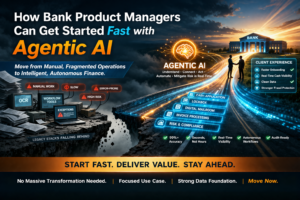
Turning agentic AI into real business impact doesn’t require a massive, all-at-once transformation. But it does require focus, discipline, and alignment with what matters most to the business. The roadmap below outlines how treasury leaders can move quickly from concept to execution while building momentum and credibility along the way.
1. Identify high-impact use cases
Focus on areas where agentic AI can deliver immediate value:
- Cash application and receivables
- Lockbox processing
- Digital mailroom operations
- Exception management
2. Build a business case tied to CEO priorities
Frame your initiative in terms of:
- Revenue growth
- Cost reduction
- Risk mitigation
- Client experience
3. Start with targeted deployments
You do not need to transform everything at once.
Begin with a focused use case, prove value, and expand from there.
Start where the pain is most visible and measurable. This builds credibility quickly with both executives and operational teams. Define clear success metrics upfront so you can demonstrate impact in concrete terms. Once value is proven, use that momentum to expand into adjacent workflows and scale adoption.
4. Plan for integration from day one
Ensure that AI capabilities are integrated with core systems and workflows, not bolted on.
Map out data flows, system dependencies, and integration points early in the process to avoid surprises later. Prioritize solutions that offer flexible, API-driven integration with your existing ecosystem. The goal is to create a seamless experience where AI enhances existing workflows rather than disrupting them.
5. Invest in change management
Technology alone is not enough.
Teams must understand how their roles will evolve and how AI will support, not replace, their expertise. Provide training, clear communication, and ongoing support to build confidence and trust. Adoption is what ultimately determines success, and that requires intentional effort.
Treasury as a Strategic Engine
With agentic AI, treasury can become a driver of growth, efficiency, and risk management, directly supporting the CEO’s most critical objectives. But this will not happen automatically. It requires treasury leaders to rethink their products, their processes, and their role within the bank.
The banks that succeed will not be the ones with the most pilots.
They will be the ones that embed intelligence into execution, turning every transaction, every workflow, and every client interaction into an opportunity to deliver value.