Treasury services have long been a cornerstone of commercial banking relationships. But the way those services are delivered is increasingly out of sync with the expectations of modern business clients.
Corporate customers now expect speed, accuracy, and real-time visibility across their financial operations. What they often receive instead are fragmented processes, delayed insights, and workflows that still depend heavily on manual intervention.
That gap is widening, and it’s creating an opening.
A new technology class, often referred to as agentic AI, is beginning to reshape how financial operations are executed. For treasury product managers, the implications are significant. Agentic AI is a fundamentally different way of running the processes that underpin cash application, accounts payable (AP), onboarding, and risk management.
Banks that move early have an opportunity to redefine their treasury offerings. Those that wait risk falling further behind fintech competitors that are already building around this model.
Why Traditional Automation Is No Longer Enough
Most banks have already invested in automation across their back-office and treasury operations. Optical character recognition (OCR) tools extract data from documents. Workflow systems route tasks. Robotic process automation (RPA) fills in gaps.
Yet despite these investments, the core issues remain.
Receivables operations still struggle with incomplete remittance data and high exception volumes. Lockbox teams continue to rely on manual balancing and rework. Digital mailrooms act as sorting centers rather than intelligent intake engines. Fraud controls are often applied late in the process, after risk has already entered the system.
The problem is not a lack of tools. It is the way those tools were designed.
Traditional automation technologies treat documents as isolated inputs. They extract limited data, often just header-level information, and pass the rest downstream. What remains – line-item detail, contextual relationships, and cross-transaction insights – is left unstructured and unused.
That missing layer is where most of the friction, cost, and risk reside.
A Shift from Processing to Understanding
Agentic AI introduces a different model.
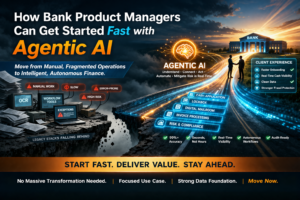
Instead of simply extracting and routing data, it connects and interprets it. Documents, transactions, and entities – customers, vendors, accounts – are linked into a unified data layer. From there, workflows are executed automatically, informed by context and reinforced by continuous learning.
This shift, from processing to understanding, is what enables meaningful change.
It allows systems to reconcile payments at the line-item level, not just match totals. It enables real-time validation of vendor and account information before transactions are executed. It embeds risk evaluation into the workflow itself, rather than treating it as a separate control step.
The result is a level of speed and precision that traditional systems cannot match. Processing times measured in seconds rather than hours. Accuracy rates approaching 99 percent at the line level. The ability to handle volume without a corresponding increase in headcount.
For banks, that translates into both operational efficiency and product differentiation.
Reimagining Core Treasury Services
The most immediate impact of agentic AI is being felt in areas that have historically been labor-intensive and difficult to scale.
Lockbox and integrated receivables are a clear example. For decades, these services have been defined by their operational complexity: handling multiple remittance formats, resolving exceptions, and balancing accuracy with throughput. As fintech providers introduce faster, more data-rich alternatives, banks are under pressure to modernize.
Agentic AI changes the equation by capturing and structuring remittance data at a much deeper level. Payments can be matched automatically, exceptions are reduced, and clients receive richer, more actionable information. What was once a back-office service has become a source of competitive advantage.
Digital mailrooms are undergoing a similar transformation. Instead of acting as intake bottlenecks, they become intelligent gateways: classifying, validating, and routing documents in real time. This has downstream effects across onboarding, receivables, and payables, where delays and errors often originate.
Accounts receivable processes stand to benefit. One of the most persistent challenges in corporate finance is the delay between receiving payment and applying it. Missing or incomplete remittance data forces teams into manual matching and follow-up, slowing cash flow and increasing costs.
By extracting and linking data across emails, documents, portals, checand transactions, agentic AI significantly reduces these delays. Payments are applied faster, unapplied cash declines, and clients gain clearer visibility into their cash positions.
On the payables side, the focus shifts to control. Payment fraud continues to rise, driven by increasingly sophisticated schemes that exploit gaps in validation and approval processes. Traditional controls, often applied at the end of the workflow, are not sufficient.
Agentic AI embeds validation earlier, analyzing invoices, vendor data, and transaction patterns before payments are released. This allows banks and their clients to detect anomalies sooner and prevent fraudulent transactions rather than reacting to them.
Risk and Compliance Become Embedded, Not Bolted On
One of the more subtle, but arguably more important, impacts of agentic AI is how it changes the role of risk and compliance.
In many organizations, compliance checks are layered onto processes after the fact. Data is reviewed, exceptions are flagged, and investigations are launched when something appears out of place.
This approach is inherently reactive.
By contrast, agentic AI integrates risk evaluation directly into the workflow. Every transaction is assessed in context, across documents, entities, and historical patterns. Know Your Customer (KYC) and Anti-Money Laundering (AML) examinations can be automated and continuously applied. Anomalies can be identified as they occur, not days or weeks later.
This creates a more proactive posture, one that aligns with the increasing expectations of regulators and the growing sophistication of financial crime.
It also produces stronger auditability. Because decisions are made within a connected system, with full traceability across data sources, banks can provide clearer evidence of how and why actions were taken.
The Economic Pressure Is Building
The case for change is economic.
Manual finance operations remain a significant cost center, with billions spent annually on processes that are slow, fragmented, and difficult to scale. At the same time, banks are facing margin pressure, rising client expectations, and increased competition from fintech providers that are unburdened by legacy infrastructure.
This combination is forcing a reassessment of how treasury services are delivered.
Incremental improvements are no longer sufficient. The gap between what clients expect and what traditional operating models can deliver is simply too large.
Agentic AI offers a path to close that gap. But it also raises the stakes. As some institutions begin to adopt this model, it will redefine the baseline for performance.
What is considered advanced today will become table stakes.
A Strategic Decision for Treasury Leaders
For treasury product managers, the question is not whether agentic AI will play a role in the future of banking operations. It is how quickly, and how effectively, it can be integrated into current offerings.
The opportunity extends beyond cost reduction. It includes the ability to:
- Deliver faster, more accurate services
- Provide richer data and insights to clients
- Strengthen fraud and compliance controls
- Create new, fee-based offerings built on enhanced capabilities
Perhaps most importantly, it offers a way to modernize treasury services without simply layering additional complexity onto existing systems.
The alternative is to continue optimizing a model that was not designed for the current environment and becomes more expensive and less competitive over time.
The Bottom Line
Treasury services are entering a new phase that rethinks how financial operations are executed.
Agentic AI is at the center of that shift.
By connecting documents, transactions, and entities into a unified, intelligent system, agentic AI enables banks to move beyond manual workflows and fragmented automation toward a more autonomous, scalable model.
For treasury product managers, this represents both a challenge and an opportunity.
The challenge is to move quickly enough to keep pace with a changing market.
The opportunity is to lead, build the next generation of treasury services, and set a new standard for what clients expect from their banking partners.
The banks that do so will redefine the competitive landscape.